As a group committed to achieving global carbon neutrality by fiscal year 2050, we view the reduction of CO₂ emissions across our manufacturing activities and product lifecycles as a critical priority and are formulating and implementing corresponding strategies.
First, the Group will reduce greenhouse gas (GHG) emissions from production activities (Scopes 1 and 2) by implementing energy‑efficiency measures and transitioning to electricity derived from renewable energy (RE). In Japan, we completed the transition to RE‑based electricity for all factories and business sites in May 2023. For our overseas subsidiaries, we will advance the transition in phases, taking regional characteristics into account. Furthermore, in fiscal year 2023, our South American subsidiary in Brazil, G‑KTB, achieved carbon neutrality by switching to RE‑derived electricity and offsetting its Scope 1 emissions with carbon credits.
Next, because purchased steel plates account for the majority of GHG emissions across the product lifecycle (Scopes 1–3), the Group will work to reduce these emissions by exploring a transition to steel plates manufactured using lower‑impact production methods and by establishing production technologies for aluminum products with superior recyclability.
We will also enhance our framework for reducing energy consumption in our manufacturing processes. By managing actual performance against planned energy‑saving targets, we will roll out effective improvement measures globally to further drive reductions in GHG emissions.
Information Disclosure Efforts in Line with TCFD Recommendations
Our Group has long advanced environmental management, positioning it as one of our material issues. Looking ahead, we will proactively enhance our disclosures to a broad range of stakeholders, including investors, in alignment with the Task Force on Climate‑related Financial Disclosures (TCFD) framework. We will identify climate‑related risks and opportunities that may impact our business activities, integrate them into our management strategy, and promote their execution. Furthermore, we will strengthen our disclosures by conducting scenario analyses and assessing the financial impacts of each identified risk and opportunity.
Governance
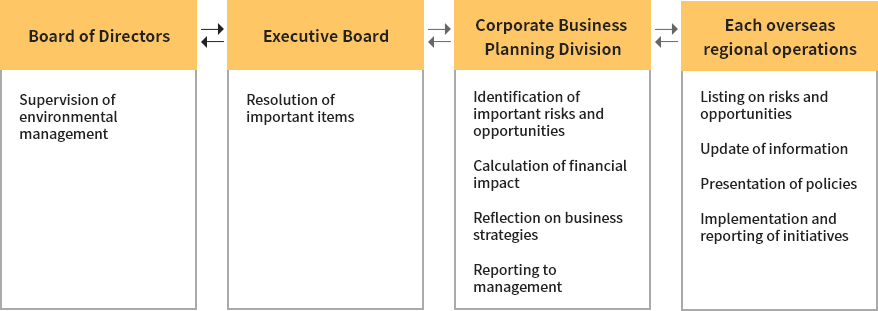
To address important issues associated with climate change, the President, Chief Executive Officer appointed as Chief Global Environmental Manager the Senior Managing Officer in Charge of the Corporate Business Planning Division, and this individual tables business strategy items that take into account risks and opportunities related to the environment and climate change, and provides reports on actual and predicted CO2 emissions.
In addition, the Corporate Business Planning Division, the secretariat of the GX project, has placed environmental responsiveness as a priority item for action. In addition, reports and opinions are offered to the Board of Directors at least once a year, depending on the matter.
Strategy
G-TEKT’s environmental strategy for business activities consists of (1) energy-saving initiatives and (2) utilization of renewable energy (including in-use power generation). Going forward, we will prioritize strategy by site at the global level, and proactively work on execution.
The environmental initiatives through our own products consists of (1) contribution to improvements of fuel and electric cost performance of automobiles through lightweight car body technologies, and (2) contribution to the spread of EVs through initiatives to further commercialize our business for EV-related parts (battery housings, cell cases, motor cores).
Taking into account developments in the automotive industry, which is closely related to our Group, broader societal trends, and the characteristics of the regions in which we operate, we have identified the risks and opportunities shown in the table below and conducted scenario analyses to assess their impacts on our business and financial performance. The International Energy Agency (IEA)’s Net Zero Emissions (NZE) scenario anticipates significant advances in the transition to electric vehicles as part of achieving global carbon neutrality by 2050. For our company, the establishment of proprietary lightweighting technologies and manufacturing technologies for electric‑vehicle‑related components ahead of competitors represents a major opportunity for future sales growth and serves as an important driver of our strategic direction.
Risks and opportunities
Reference scenario
・2℃ or lower scenario NZE (IEA 2022)
・4℃ or higher scenario RCP8.5 (IPCC AR5)
Timescale
・Short term: less than five years; Medium term: less than 10 years; Long term: up to 2050
Financial impact
・Small: ¥0.05 billion to ¥0.1 billion; Medium: ¥0.1 billion to ¥0.5 billion; Large: over ¥0.5 billion
Risk Management
Our Group holds discussions with the Global Environmental Department, the responsible personnel and relevant departments at each overseas subsidiary, and the Central Environmental Promotion Committee regarding climate‑related risks and opportunities subject to management oversight. We have confirmed that, at this stage, there are no material deviations from external trends, and we are sharing updates on the progress of internal countermeasures.
We will conduct strategic planning and formulate policies by sharing external factors—such as global trends, including climate‑related developments that influence business strategy, as well as changes in laws and regulations—and by taking into consideration internal factors, including each company’s progress on environmental initiatives and future risks and opportunities.
Indicators and goals
As an indicator for managing climate change risks and opportunities, we have set global emission reduction targets for Scopes 1, 2, and 3 CO2 emissions. In terms of G-TEKTʼs global Scopes 1 and 2 CO2 emissions, we are aiming for a 50% reduction in CO2 emissions in FY 2030 and a 100% reduction in FY 2040 compared to FY 2013. We also aim to be carbon neutral as defined in Scopes 1, 2, and 3 by FY 2050, with cooperation in the supply chain.