Evolution of Full‑Body Development
Relentlessly Pursuing Optimal Vehicle Body
As automobiles continue to evolve and diversify, the required structures and functions of vehicle bodies are also changing.
As a vehicle body parts manufacturer, we are advancing our development efforts to propose a unique platform that achieves both functionality and cost efficiency across the entire vehicle body.
Open Innovation
Key Factors for Delivering “Proposal‑Driven Development” and “Integration Power” as a Tier 0.5 Supplier
We actively pursue joint research and technical collaborations with companies from other industries and academic institutions to continuously incorporate new materials and manufacturing methods rather than being satisfied with our existing technologies.
Expanding our technological capabilities requires flexible thinking and diverse perspectives. By connecting with external partners, exploring broader possibilities, and working together at speed to define and resolve challenges, we strive to build the next generation of technologies.
R&D Network
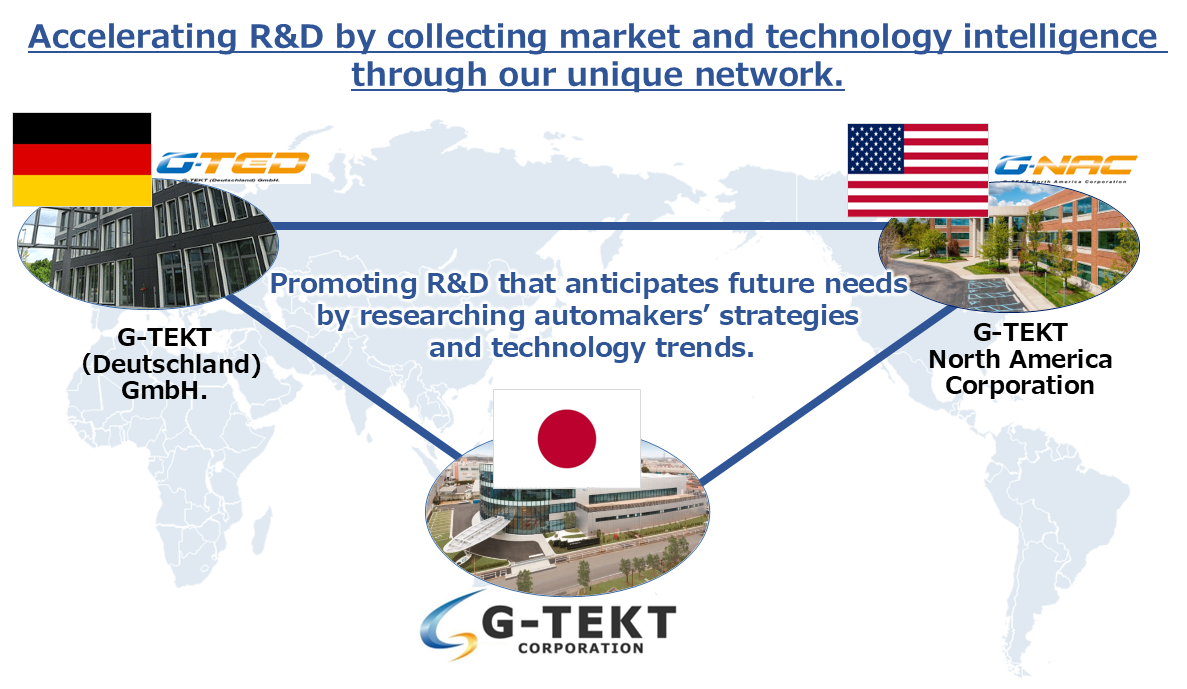
G‑TEKT’s global R&D network, with GTL at its core, effectively captures regional technological needs and market trends by leveraging our Sales & Engineering (S&E) sites, which function as antennas in key markets.
By collaborating across the globe, we accelerate both our technology and sales strategies, driving our overall growth strategy.
R&D Environment
G-TEKT TOKYO LAB (GTL) is a dedicated R&D hub that integrates analysis and testing functions to enable full vehicle body development, shaping the cars of the future.
Here, members who are eager to transform automotive manufacturing through fresh ideas come together to propose and implement new technologies in line with the evolution of automobiles, including collision safety, environmental performance, and electrification.
Leveraging on-site expertise
One of G‑TEKT’s key strengths is our integrated system that spans from development to mass production, enabling us to feed insights gained on the shop floor directly back into our R&D activities.
This integration allows us to conduct research and development that fully incorporates considerations for productivity in mass‑production environments.